John Solomon, the life-affirming voice of this blog, died Monday, November 1, from complications following a bone marrow transplant for leukemia. He was 47.
To readers of this blog, this news is not only devastating but also shocking. We knew that John was struggling for the past two years, but it was sometimes easy to get the wrong idea about the seriousness of what he called “this pesky” condition. It’s not that John ever hid anything — on the contrary, he was refreshingly candid at all times (most notably here). It’s just that he was so consistently sanguine that his illness often seemed like more of an annoyance than a life-threatening event.
John is survived by his wife Abby, his two children Rebecca and Sara, his parents Ann and Richard, his brother Jimmy, and by his many friends and admirers. The funeral service will be Wednesday, November 3rd, 10:00 am at Temple Emanu-El, on Fifth Avenue at 65th Street. John left behind a charitable fund, The John D. Solomon Memorial Fund (â„… The New York Community Trust, 909 Third Avenue, New York, NY 10022). He was particularly encouraging of blood donations and bone marrow donations. For those  who don’t yet know: it is now amazingly easy and painless to give bone marrow. It’s basically just like giving blood (more about that here). Please consider honoring John by becoming a donor.
John was extraordinarily capable, and would have made a major contribution to any field. He loved his work in disaster preparedness, and felt that he was making a difference. He was. This blog was originally supposed to be a mere prelude to an important book about disaster policy, but it became a major work in its own right. I do not know whether John’s book will ever be published. But with his online work, and his memorable conversations with responders, policymakers, scientists, and journalists, he leaves behind a distinguished legacy of skepticism, curiosity, and a determination to make things right. I know his family is proud of his work, and plans to maintain this site as a resource.
There’s much more to learn about John and his giving life in this New York Times obituary. He was a terrific person doing important work, and it was my honor to know him.
- David Shenk
John Solomon, the life-affirming voice of this blog, died Monday, November 1, from complications following a bone marrow transplant for leukemia. He was 47.
To readers of this blog, this news is not only devastating but also shocking. We knew that John was struggling for the past two years, but it was sometimes easy to get the wrong idea about the seriousness of what he called “this pesky” condition. It’s not that John ever hid anything — on the contrary, he was refreshingly candid at all times (most notably here). It’s just that he was so consistently sanguine that his illness often seemed like more of an annoyance than a life-threatening event.
John is survived by his wife Abby, his two children Rebecca and Sara, his parents Ann and Richard, his brother Jimmy, and by his many friends and admirers. The funeral service will be Wednesday, November 3rd, 10:00 am at Temple Emanu-El, on Fifth Avenue at 65th Street. John left behind a charitable fund, The John D. Solomon Memorial Fund (â„… The New York Community Trust, 909 Third Avenue, New York, NY 10022). He was particularly encouraging of blood and bone marrow donations. For those  who don’t yet know: it is now amazingly easy and painless to give bone marrow. It’s basically just like giving blood (more about that here). Please consider honoring John by becoming a donor.
John was extraordinarily capable, and would have made a major contribution to any field. He loved his work in disaster preparedness, and felt that he was making a difference. He was. This blog was originally supposed to be a mere prelude to an important book about disaster policy, but it became a major work in its own right. I do not know whether John’s book will ever be published. But with his online work, and his memorable conversations with responders, policymakers, scientists, and journalists, he leaves behind a distinguished legacy of skepticism, curiosity, and a determination to make things right. I know his family is proud of his work, and plans to maintain this site as a resource.
There’s much more to learn about John and his giving life in this New York Times obituary. He was a terrific person doing important work, and it was my honor to know him.
During hurricane season and National Preparedness Month, state and local emergency management offices in communities around the U.S. will often work with private businesses to promote public readiness. Typical is North Carolina County Emergency Management Services hurricane project with the United Way in which:
Stores across the area are hosting a Hurricane Preparedness and Awareness event throughout the weekend.
There will be tables set up in all stores providing shelter information, preparation checklists, pet needs, as well as special needs and senior citizen registration forms.
These types of events with information distribution and registration set up near preparedness supply displays are a net positive as they do bring attention to the subject, the creation/replenishment of some shoppers’ emergency kits and occasionally fundraising for the non-profits. However, they end up being far short of what is necessary. That’s too bad since there is such great potential for what could be accomplished if the government, non-profit preparedness groups and businesses in the field really focused in a creative, sustained way on what they could do together to address the shortcomings in citizen disaster readiness.
The key is to restructure these kinds of events to give the public far more real, tangible and significant incentives (primarily financial but also logistical, educational and even entertainment) to prepare, which is something that business working with government and non-profits could do as part of an integrated, ongoing marketing campaign. The fact is that when we really want to change social behavior as a nation we do it through the carrot or the stick. The carrot is the preferable tool for this issue, but it needs to be used. And, thus far, incentives and vegetables have largely been missing from the preparedness effort, which helps explain the lack of progress.
There is a need to design and implement new citizen preparedness campaigns using strategic marketing partnerships between government and business with the goal of significantly increasing public readiness and societal resilience.
My proposal in a nutshell is that marketing campaigns and events be created at a national, state and local level to with government and non-profits working with companies in preparedness-related products businesses to offer major discounts tied to citizens taking actual readiness steps recommended by Ready.Gov and local emergency management offices.
It is a subject that I have thought a lot about, largely because I think that getting private sector far more involved in emergency citizen preparedness is a (maybe ‘the’) key to improving citizen readiness. I have also spoken extensively with government, non-profit and corporate officials about how they might work together on advance preparedness in a way that serves their (and the public’s) interest. My strong feeling is that to do so would not take much more than more attention and focus and would result in a win-win-win-win for those stakeholders and the citizenry.
At last week’s Red Cross Emergency Social Data Summit, FEMA Administrator Craig Fugate underscored the role of the private sector in disasters. “We have to figure out how leverage government and private sector resources to change outcomes.”
He said private sector involvement should be seen as a “bottom line” issue rather than just a feel-good pr move. That’s clear after a disaster as companies try to re-open quickly to serve customers in the community. And, that business-case approach should be similarly applied when it comes to advance preparedness. The fact is that the more prepared the public is, the better it is for the private sector. Business is key because as Fugate told me last year, “the bully pulpit is not enough”.
Government officials realize they need significant private sector involvement to market preparedness to the public, but have been unable to pull such an integrated program together as marketing is not government’s expertise. However, public preparedness needs to be developed and marketed as a consumer brand. Particularly since Hurricane Katrina, the corporate sector has become far more involved in disaster policy, but it has focused mostly (and often very successfully) on post-event recovery and response. Yet, there has been little attention given to have the private sector help create pre-event initiatives and messaging that would prepare citizens and institutions for emergencies in advance.
Government citizen preparedness campaigns over the past few years have raised awareness but not significantly enough to change societal behavior. This has been due to a lack of reach, frequency and sustainability of the communication, and the public’s inability or unwillingness to follow the actions recommended. No matter how good and robust the message, behavior will not change unless actions being recommended are made more turn-key, familiar and affordable. Government officials ask the public to buy supplies, make plans and educate themselves without offering them enough assistance to accomplish these not insubstantial tasks (and are asked to do so with even less incentives than other public sector campaigns provide).
Yet, the current conditions would appear to be auspicious for such an new corporate/government partnership to take on preparedness: the public is interested in becoming more prepared; major corporations are committed to the disaster issue and can offer products, resources and capacity. For them, preparedness provides excellent opportunity to ‘do good and do well’ increasing store traffic and selling products while improving community resilience; and non profit preparedness groups, most prominently the American Red Cross, have the experience and credibility to facilitate this partnership. And, as mentioned above, a priority of FEMA Administrator Fugate is to get the private sector involved in a way to “change outcomes”. Yet focus, coordination and leadership are still necessary “to connect the dots†for each stakeholder.
The range of disaster preparedness products from manufacturing companies that can be involved are endless: Bottled Water, Flashlights;Â Wireless Phones, Radios;Â Energy Bars;Â Canned Food; First Aid Kits. On the retail side, it can involve any store that sells these products, particularly ‘big box’ outlets and supermarkets. The campaign would also involve corporate trade groups, such as the Wireless Foundation and the Business Roundtable, which have been very involved in getting their members involved in disaster issues.
An example of the type of preparedness event I’m thinking about would include “In-Store Workshops” but with significant discounts and giveaways tied to information and actual completion of readiness steps:
* Big-Box/Grocery Stores Supply Kit Creation-Replenishment – This would be similar to the current preparedness in-store events. However, they would be far more involved and would offer consumers more benefits and assistance for coming in. There would be a specific area where employees along with local Community Emergency Response Team (CERT) and Red Cross volunteers would be answering readiness questions.
Advertisements in advance would invite individuals and families come in with emergency communications plans (or fill them out in the store) and in return they would receive a significant discount on supplies or free products (ie. if you purchase a case of bottled water, you would get your emergency supply thrown in). And if a customer signed up to volunteer to CERT or Red Cross Disaster Services volunteer, they would get a bigger discount.
In addition, customers would be provided branded bags so adults — and kids — can make/replenish their own ‘go-bag’ (if they didn’t want to buy a pre-made kit). Again, the stores would discount the supplies significantly and CERT, Red Cross and government  officials would be there to answer questions.
* Mobile Phone Retail Outlets – The mobile communications companies are eager to show their value of their products  to customers in emergencies so their retail stores would be excellent settings for preparedness events/trainings. Among the activities that could be set up: helping people register for government emergency text/e-mail alerts. I’d also like to see a event/photo-op with kids teaching their parents about texting and its role in an emergency. Here again, the companies would offer customers extra free text/phone minutes for completing the preparedness steps (I’d also like to see discounts on extra batteries though the companies do make excellent margins on the extras.)
I also think this setting would be a good place for people to learn about how the role of social media sites like Facebook and Twitter to help people in a crisis. can be very usewith be a place for families and friend also  and families and friends setting up social media sites, such as Twitter and Facebook, to teach how they can be used before and during emergencies.
Government could also increase the effectiveness of such an initiative by creating tax-free preparedness product periods as Virginia and Louisiana have (and we’re trying to do here in New York), which add more financial incentives, increase store buy-in and garner more media attention for preparedness.
The key is to pull all of these stakeholders together — connecting the information with accessible, useful and affordable products along with expert and peer-to-peer guidance –in a sustained, integrated way. I will be continuing to work on these partnership ideas and would be interested in any thoughts from readers.
These icons link to social bookmarking sites where readers can share and discover new web pages.
The big show business news of this past week was that the three “American Idol” judges — Jennifer Lopez, Steven Tyler and Randy Jackson — have been officially announced.
“My Family Disaster Plan,” was supported by a grant from “Idol Gives Back”, the show’s annual fundraising event. The piece was released last year when this blog was on hiatus so I am posting it now.
You can download “My Family Disaster Plan” here. Thanks to the Twitter feed @kidsgoape for bringing this to my attention.
These icons link to social bookmarking sites where readers can share and discover new web pages.
Alabama’s innovative “Be Ready Sunday,” initiative encouraging faith-based organizations to educate their congregations on how to respond when a man-made or natural disaster strikes takes place this weekend. It should be replicated in other parts of the nation.
The Governor’s Office of Faith-Based and Community Initiatives and the Alabama Department of Homeland Security are encouraging religious leaders of all faiths on Sunday, September 26th, 2010, or your nearest day of worship, to inform their congregations on how to Be Informed. Be Involved. Be Ready…
We are encouraging religious leaders to include disaster readiness information in their Sunday bulletins, website or speak on the importance of disaster readiness bringing the congregations attention to the importance of disaster preparedness.
These icons link to social bookmarking sites where readers can share and discover new web pages.
The idea is to test the speed and widen the scope of responses to a major disaster, focusing on how social media sites like Facebook and Twitter can be used. ”Ultimately, the goal is to get there faster, respond more effectively to save lives, communities, businesses, etc.,” read a written release on the drill. Organizers said that all messages about the fictional disaster would be marked clearly as fake on the Web.
Shortly after 12:30 p.m. ET, organizers began sending fictional messages from an account on Twitter reporting the disaster.
“#X24 IS A TEST, NOT REAL [link] CNN.com Earthquake strikes coast of Southern and Baja California http://bit.ly/Exer24 1 …,” was the first mention.
Instead of a CNN story, the link went to a Web page explaining the drill and how users can participate. As time went on, details included reports of snapped bridges, severe flooding and a tsunami on the way.
“#X24 IS A TEST, NOT REAL TV said large wave headed toward coastline! Everyone get out! http://bit.ly/Exer24 3-9 …,” read a later post.
For more information and to participate in the ongoing exercise, check its Twitter and Facebook sites.
These icons link to social bookmarking sites where readers can share and discover new web pages.
Thanks to Hal Grieb for flagging two eye-catching preparedness fashion items that seem to combine both form and function. And I thought it would be of interest for those who follow what the Portland Red Cross likes to call Prepare-aphernalia.
Caught in a disaster? You’d better hope you’re wearing the Emergency Bra. Simply unsnap the bright red bra, separate the cups, and slip it over your head — one cup for you, and one for your friend.
Dr. Elena Bodnar won an Ignoble Award for the invention last year, an annual tribute to scientific research that on the surface seems goofy but is often surprisingly practical. And now Bodnar has brought the eBra to the public; purchase one online for just $29.95…
It sounds silly, but Bodnar, a Ukraine native who now lives in Chicago, started her medical career studying the effects of the 1986 Chernobyl nuclear plant disaster. If people had had cheap, readily available gas masks in the first hours after the disaster, she said, they may have avoided breathing in Iodine-131, which causes radiation sickness…
According to a report on tech news site CNET, there are plans for a “counterpart device for men” in the works, though the precise shape it will take has yet to be revealed.
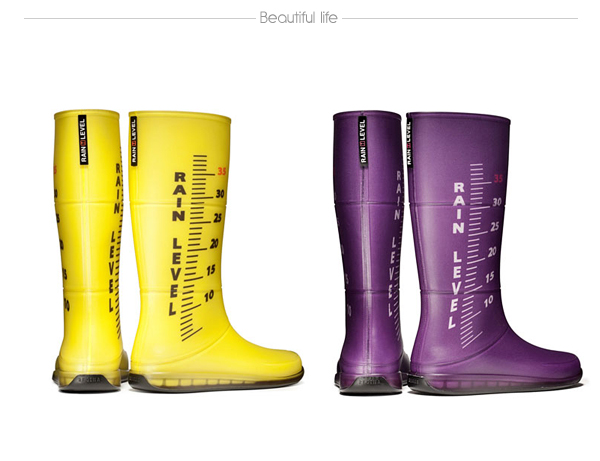
Earlier in the week, Hal also tweeted about another preparedness fashion accessory — rain boots with centimeters measurements on its side — from a company called Regina Regis, which come in a number of colors (I picked a couple of the most colorful to show below):
These icons link to social bookmarking sites where readers can share and discover new web pages.
I recently watched a review copy of Harry Shearer’s new documentary “The Big Uneasy,” which examines the underlying reasons for the Hurricane Katrina disaster. The movie was particularly striking to me in that it takes a rare non-partisan approach to the topic.
In fact, Shearer — the actor, comedian, activist and a New Orleans resident – said he was provoked to make the movie when President Obama ”referred to the flooding—in passing—as ‘a natural disaster.’ I just hit the roof. I went, ‘OK, blogs and radio and all the other things I’ve been doing clearly aren’t enough. I know what the next step is.’ And it was this.â€
Shearer’s major point in “this” is that Katrina was a man-made — not a natural — disaster. And, the men (and women) who were most responsible for making it a disaster is the Army Corps of Engineers whose mismanagement, the movie argues, caused the city’s levees to rupture during the storm. And, “The Big Uneasy” further contends that many the same issues the first time around are being repeated in the rebuilding process.
For more information about the film including where it is showing, click here.
“The Big Uneasy” director and New Orleans resident Harry Shearer.
These icons link to social bookmarking sites where readers can share and discover new web pages.
Over the past few weeks, emergency evacuation has been necessary in different parts of the nation from the wildfires in Colorado and Utah to Hurricane Earl that impacted towns and cities straight up the East Coast.
What has been particularly interesting to me is the dichotomy between the communities that are accustomed to evacuating and others that are not. When Earl threatened the Eastern Seaboard where (and whether) it would hit land was unclear so all areas were at least contemplating evacuation if not implementing it.
North Carolina’s Outer Banks undertook an evacuation, but that is old hat for residents of that often-threatened community. But by contrast, other (especially more urban) areas do not have that evacuation muscle memory. For a time, there was a concern that heavily-populated places, like Long Island without evacuation track records, were in the storm’s path. There was even thought that residents of low-lying areas of New York City might have to leave their homes. Of course, Earl luckily swerved into the Atlantic and we moved on to the next subject. But I still have significant concerns that this area could undertake a major evacuation at the present time even with warning.
Nevertheless, when government officials talk about the subject of emergency evacuation with the public and the media they don’t normally differentiate between communities that are evacuation veterans and those which are not.
Further, and more seriously I would argue, is the question of unexpected evacuation due to an unexpected incident such as a terrorist attack that could impact all parts of the country. It is an even more complex challenge which receives very little discussion at the local and national levels. In fact, most emergency authorities ask citizens to create and rehearse their own plans with little guidance (and so it shouldn’t be surprising why so few folks have). As has been mentioned frequently on the blog, there is a need to work through these issues together. To me, it could be even integrated into existing fire evacuation as well.
It would have been nice if some of these warnings, such as Hurricane Earl, would have provoked the public, the media and government officials to focus attention on the challenge of unexpected evacuation. It would be an opportunity to discuss further concepts such as ’shelter in place’.
But I think the fact that Outer Banks residents and tourists are able to evacuate the barrier islands swiftly and orderly is fooling the nation that somehow we are on top of the issue of emergency evacuation. It is time that this topic gets more attention, because officials are warning that the unexpected is actually the expected.
Residents and tourists on North Carolina’s Outer Banks evacuate before Hurricane Earl.
These icons link to social bookmarking sites where readers can share and discover new web pages.
In this edition of the blog’s “What Should We Tell The Public?” video series, Holt recommends that citizens “do a risk analysis” of their area and then prepare for those risks. As part of that preparation, Holt recommends that people equip their cellphones in advance with important numbers such as the local police’s non-emergency contact and the U.S. government’s terrorism tips line. And, he suggests that citizens have a responsibility to contact their local, state and federal government officials proactively to tell them what information they need to be ready for emergencies.
Jack Holt, Senior Strategist for Emerging Media, U.S. Department of Defense (”What Should We Tell The Public?”)
These icons link to social bookmarking sites where readers can share and discover new web pages.
The City of Dallas wants the public to “help us determine how the Office of Emergency Management (OEM) can better serve you when it comes to social media.” Dallas OEM has created a short survey with a few basic social media questions for citizens. It is also polling other public safety agencies on the same subject.
The surveys are actually part of academic research being done by City of Dallas Emergency Management Specialist Raymond Rivas, a 4th year student in the Executive Fire Officer Program at the National Fire Academy in Emmitsburg, MD. Part of the program requires that after each class you must write an Applied Research Paper pertaining to an issue that affects your jurisdiction.
The results will be interesting in large part, because the City of Dallas OEM’s social media presence is still in its infancy so officials are probably going to learn a lot. If you want to participate in the seven-question citizen survey (and it is open to anyone), click here (deadline is October 1).
These icons link to social bookmarking sites where readers can share and discover new web pages.